Wednesday, April 30, 2014

The Road to Emmaus

Now on that same day two of them were going to a village called Emmaus, about seven miles from Jerusalem, and talking with each other about things that had happened.  While they were talking and discussing Jesus himself came near and went with them, but their eyes were kept from recognizing him.  And he said to them, "What are you discussing with each other while you walk along?"  They stood still, looking sad.  Then one of them whose name was Cleopas answered him, "Are you the only stranger in Jerusalem who does not know the things than have taken place there in these days?"  He asked them, "What things?"  They replied, "The things about Jesus of Nazareth, who was a prophet mighty in deed and word before God and all the people, and how are chief priests and leaders handed him over to be condemned to death and crucified him.  But we had hoped that he was the one to redeem Israel.  Yes and besides all this, it is now the third day since these things took place.  Moreover, some women of our group astounded us.  They were at the tomb early this morning, and when they did not find his body there, they came back and told us they had indeed seen a vision of angels who said that he was alive.  Some of those who were with us went to the tomb and found it just as they had said; but they did not see him."  Then he said to them, "Oh how foolish you and, and how slow of heart to believe all that the prophets have declared!  Was it not necessary that the messiah should suffer these things and then enter his glory?"  Then beginning with Moses and all the prophets, he interpreted to them the things about himself in all the scriptures.

As they came near the village to which they were going, he walked ahead as if he were going on.  But they urged him strongly, saying, "Stay with us, because it is almost evening and the day is now nearly over."  So he went in to stay with them.  When he was at the table with them, he took bread, blessed and broke it and gave it to them.  Then there eyes were opened and they recognized him; and he vanished from their sight.  They said to each other, "were not our hearts burning within us while he was talking to us on the road, while he was opening the scripture to us?"  That same hour they got up and returned to Jerusalem; and they found the eleven and their companions gathered together.  They were saying, "The Lord has risen indeed and he has appeared to Simon!"  Then they told what had happened on the road, and how he had been made known to them in the breaking of the bread.

Luke 24: 13-35
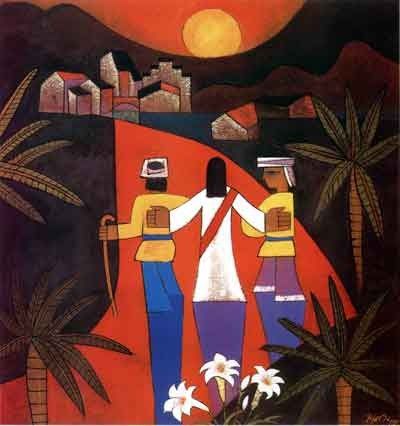


Our scripture tells the story of two weary, sad and disoriented travellers trying to make sense of a week that has them reeling.  They are on their way home; they have seven miles to talk, or to share silence, to simply put one foot in front of the other.  When they are joined by the third traveller they must have been engaged in conversation as the stranger asks them what they are talking about.  They seem taken aback by the question, is anyone talking about anything else other than the events of the week which culminated in the crucifixion of Jesus?  And now the word from the women that his tomb is empty and he is alive?

The identity of the stranger is unknown to the two travellers.  Jesus, the one whom they are talking about - the prophet mighty in word and deed is in their midst but they are unable to discern his identity.  What was it about about seeing Jesus after the resurrection that made him hard to recognize?  Resurrection challenges everything we believe about life and death and even though these followers of Jesus might have known about resurrection they likely would not have expected it to occur on earth. It was for eternity with God; not for "walking on the same old roads, on the same old ground they had grown up on and talked on and worked on, with the same old people they had grown up with." (Peterson, p.67) Is it also possible that these travellers never imagined Jesus would appear to them?  Could they not recognize Jesus because they were "foolish and slow of heart"? Was it because their hopes were utterly dashed and they were unable to imagine how God could redeem Israel now? Did Jesus want to remain veiled so that he might teach them first and help them see himself and themselves in light of the resurrection?  To see how the resurrection fits into the larger narrative and is the fulfillment of God's plan? Or maybe Jesus was just content to walk and be present and wait with these two travellers until they saw with the eyes of their hearts who he was.

The stranger begins with a question and goes on to engage the travellers; he listens to them, creates space for their questions and for their disappointment.  He speaks directly to them and opens up the word of God; he puts the events of the past week into the much larger story of God beginning with Moses and all the Prophets.  His words are potent, the travellers are cut to the heart. Have you ever walked with a friend through a time in life that was difficult, disorienting, grievous?  A time when you wondered where God was; who he was?  How did you experience the presence of Christ?  Do you have a recollection of someone who reflected Christ to you? Were there words of scripture or words of writers that were dear to you? Did anyone ever open up the Word of God in a way that caused you to see - as if you were seeing for the first time?  Here, Jesus the Word interprets the word and the hearts (minds and feelings) of the travellers burn within them.

The travellers are getting close to Emmaus and though they are tired and hungry they almost wish they had more time on the road together. The sun is falling in the sky so they plead with the stranger to stay for the night.  He agrees, comes to their place and sits down at the table.  It is a simple affair, no one has fussed over a menu or gone to elaborate preparations but the food and wine provide the travellers with sustenance and rest and it is as good for the soul as it is for the body to be together around the table and be nourished.  The guest takes the bread, blesses it, breaks it and gives it - he becomes the host. And at in a moment it all becomes clear to the travellers.  He is Jesus!  One can just imagine the exhilaration of the moment of recognition.  And as soon as they realize who he is, Jesus is gone.  The travellers don't just finish their meal, delighted at this time they have spent with Jesus and tuck into the deepest and most peaceful sleep they have had in years.  No! That same night they returned to Jerusalem to tell the others what has happened.  

There is a noted pattern in meals that we read of in scripture, often three to four verbs appear: taken, blessed, broken and given.  You have likely heard it most often, "The Lord Jesus on the night when he was betrayed took a loaf of bread, and when he had given thanks, he broke it and said, "this is my body that is for you.  Do this in remembrance of me."  Jesus life: taken, blessed, broken and given for the life of the world.  These words: taken, blessed, broken and given are the shape of our liturgy and our lives.
Jesus takes what we bring him, he takes us and gives thanks and blesses what we bring, who we are in our bringing.  He offers it up to God and into the person of the Godhead and the operation of the Trinity.  Jesus breaks what we bring him. We cannot come to the table with pride, with pretense, with hard hearts, with demands - Jesus breaks through this so that we might be open to new life, to new action.  We discover the brokenness of Jesus and our own and we find our healing in his broken body.  "And Jesus gives back what we bring him, who we are. Only it is not what we brought.  Who we are, this self that we offer at the table has been changed into what God gives and what we sing about as amazing grace."  Transformation takes place at the table in the resurrection meal of bread and wine.  "Christ in me." (Peterson, pg. 94)

This story contains themes of journey, friendship, honest conversation that grapples with the biblical narrative and our daily lives, the presence of Christ both hidden and revealed, the practice of hospitality, and the table (communion table and dinner table) as the place around which our lives our formed in Christ, in resurrection wonder. As you reflect on this story and prepare your lessons may the Word cause your hearts burn within you!


Oil Painting in Tibet 16, by He Qi, China


Both images are inspired by this text and done by the artist He Qi

All Peterson quotes are from, 'Living the Resurrection: The Risen Christ in Everyday Life'


Wednesday, April 23, 2014

Jesus Appears to the Disciples!

Last week we celebrated the Feast of Easter the oldest and most important feast of the church year.  But Easter is not over, in fact it lasts for fifty days.  Eastertide is a season of celebration and joy as we reflect on God's divine act of forgiveness and liberation; the new life that is offered to us in Jesus' death and resurrection.  All four gospels tell post-resurrection stories, they begin with Mary Magdalene who meets Jesus near the tomb where he was buried.  This week we hear the story of his first appearance to the disciples.  We take time to reflect on the wonder, the disbelief, the questions, the grace of Christ who appears to his followers with peace, with forgiveness, with an invitation to Follow Him.

This week our text is from John 20:19-29, in our Sunday School curriculum the text is titled: "Doubting Thomas"- this might be how you know the text as well.  However, when we tell the story with the two words, "Doubting Thomas" it is very easy to hear it in a negative light or to miss the grace and mercy in this story of Christ's appearing.  So perhaps when we might simply call it Seeing and Believing?  I will leave that with you to decide.

Our text today records that the disciples are on lock down. They have heard Mary's report - she has seen the risen Lord, she has heard his voice, wrapped her arms around him.  They gather together disoriented and weighed down; unsure of how to proceed.  They are desperately afraid of the religious authorities who have just crucified Jesus, they are ashamed of how this has all unfolded, how they deserted and denied Jesus.  They might even be afraid to see him, after all what might he say to them?  The doors are locked.  And yet despite this fact, Jesus comes into their midst and he says "Peace be with you." The words echo back from the Last Supper, "My peace I give you, my peace I leave with you.  I do not give to you as the world gives.  Do not let your hearts be troubled and do not let them be afraid." But this time the words carry a different weight, Jesus is offering peace as the resurrected one, the one who has suffered and prevailed.  He is in their midst and his first words to them do not express disappointment, his words to do not shame them or make them feel guilty. Instead Jesus offers peace and forgiveness unburdening the disciples; relief and joy washing over them.

The disciples are loved and chosen by God and in the room, with their hands in his, they know who he is - their Saviour.  Maybe the words of Isaiah were running through their minds "He was wounded by our transgressions and by his wounds we are healed." Perhaps they were thinking back to all  the people Jesus healed with his hands, with his breath, with words.  And now Jesus breathes on them, the life giving breath of God, the Holy Spirit.  And Jesus gives them a task: to forgive others as they have been forgiven.  They know the power of forgiveness, they had been locked in a room, afraid and ashamed and now they are sent out into the world - free, to love and forgive as Christ has.  The transformational life of the Spirit is at work in them and in us!  The work of forgiveness is all of ours as followers of Jesus; we pray how Jesus taught us when we say, "forgive us our sins as we forgive those who sin against us."  Forgiveness is the hard work and the gift that transforms relationships and frees us from fear and sin.

Thomas is the only one not present in the room with them; for some reason, he is absent.  And when the disciples tell him what has happened he cannot simply believe upon their report.  Maybe he too just wants to see Jesus and touch him one more time, to see his resurrection body with his own eyes.  We don't know what his disbelief is all about.  But we can often identify in ourselves a refusal to believe, can't we?  Sometimes it is the refusal to believe that we can be forgiven or loved by God - we can even keep serving God, still not believing.  Sometimes disbelief or misconceptions about who God is makes it hard for us to recognize Jesus.  Sometimes we have hard questions that we need to wrestle with  and we need a place where there is room for faith and for our hardest questions.  Maybe Thomas isn't that different than Mary or the disciples or us.  In our story today, Jesus comes to Thomas, again the disciples are gathered behind closed doors and he offers his peace; he shows Thomas his hands and his sides.  It is an act of mercy, of love.  Thomas recognizes this and exclaims: "My Lord and My God."  The last two verses of this chapter read, "And truly Jesus did many other signs in the presence of His disciples, which are not written in this book; but these are written that you might believe that Jesus is the Christ, the Son of God and that believing you might have life in His name." (John 20:30,31)  Belief that brings us into life - this is the good news of Eastertide!

The students might also be curious about the body of the resurrected Christ.  We read that he could pass through doors in this chapter which is very curious.  And yet he was not ghostlike, he could be touched and was recognizable; he ate with the disciples on the beach.  So his body was like ours and yet not like ours.


Here is an image by Caravaggio, you might want to share with students this Sunday.


A blog I like had some great ideas that pick up on the idea of recognizing Jesus, just as Thomas and Mary and the disciples recognized Jesus.  Check out them out over here:
Flame: Creative Children's Ministry

And a poem for you, by Luci Shaw:

Open
John 20:19, 26

Doubt padlocked one door and
Memory put her back to the other.
Still the damp draught seeped in, though
Fear chinked all the cracks and
Blindness boarded up the window,
In the darkness that was left
Defeat crouched in his cold corner.

Then Jesus came
(all doors being shut)
and stood among them.

Thursday, April 10, 2014

Palm Sunday, The Road to Jerusalem

This past week I saw a picture my eight year old god-daughter drew.  In her picture she depicted the hill of crucifixion with three crosses on it - it read: Where He Died... The End.  And then, in the bottom right hand corner in rather small font it read: (or is it?).  What a brilliant picture, 'Where He Died... The End... (Or Is It)?'  This is Holy Week beginning with the joy and bold proclamation of Palm Sunday that soon gives way to a world thick with tension and conflict; fierce with passion, with flickering hope, with overwhelming fatigue and yet pulsing with energy, with intimacy and betrayal, brutality, violence, profound failure, with LOVE, victory, praise, lament, loss, death, grief, disorientation and resurrection - new life.

It begins as Jesus enters into Jerusalem on a donkey just as Zechariah prophesied: "Rejoice greatly, O daughter Zion! Shout Aloud, O daughter Jerusalem! Lo, your King comes to you; triumphant and victorious is he, humble and riding on a donkey, on a colt, the foal of a donkey."  I love this particular bit - "your King comes to you triumphant and victorious and humble and riding on a donkey" (hint: he is not an ordinary King).  This King, the Son of God rides into Jerusalem on a donkey, not a war horse clad in armour with top ranking army officials around him. Our King comes not by might or power but in the Spirit of the Lord to claim the freedom of all people.   A large crowd followed him out of Jericho, and more had been gathering from the wayside, from villages, they were crying out for mercy and declaring Him to be the Son of David, the Lord, and he was healing them. They were moved beyond words to action; they threw down their cloaks, cut down branches from trees and began to wave them.  They went before him and behind him, they shouted: "Hosanna to the Son of David! Blessed is he who comes in the name of the Lord! Hosanna in the highest heaven!" Their cries could be heard from far off, before they even entered the city, they were proclaiming Jesus: Emmanuel, God with us.  It must have been quite the parade!

Jesus will enter Jerusalem and the scene will rapidly change.  He walks into the temple, the place he had known as a young boy, where he sat with teachers and learned from them.  And what he sees enrages him: "he saw moneychangers buying and selling, vendors hawking doves for those who had come from the countryside to make sacrifices" with emotion coursing through him - he drives out the buyers and sellers, he throws over the tables of money changers.  All blind and the lame in the streets clamour in to the temple to see Jesus and he heals them.  The children cry out: 'Hosanna to the Son of David!" The chief priests and Scribes are angry, they are threatened, humiliated even.  How dare he come into the temple and do this? Jesus leaves the city.  The tensions are rising, religious leaders are questioning his authority and trying to undermine him. Jesus will not be tricked, duped or stupified by their questions.  His words are potent: "Truly I tell you, the tax collectors and the prostitutes are going into the kingdom of God ahead of you.  For John came to you in the way of righteousness and you did not believe him, but the tax collectors and the prostitutes believed him; and even after you saw it, you did not change your minds and believe him."  The religious leaders are making a case against him, he has broken their rules, he has publicly spoken out against them! He is hanging out with the wrong people, in fact he is often found in the company of unclean, sick and decidedly un-holy people!  He is speaking of giving to those in need, of sharing with others! He speaks of forgiveness and of loving your enemy!  The religious leaders and the rulers of the day feel that this must stop.  This Jesus movement threatens to undo everything that keeps them in their places of power and prestige.  And so people are plotting against him behind closed doors, whispering in back rooms, pointing, asking questions and making accusations.

This week we pick up the story in Matthew 26, as we will have read the Palm Sunday account upstairs.  This is a long text so in each of your lessons this week they have included either story cards to be ordered after hearing the condensed story or breaking up the story into sections and working together to create a time line of events.  I think both of these methods are effective ways to make sense of Holy Week for students.  I will be sure there are enough story cards for students in grades 1 and 2 and I will set out the necessary supplies.  For the older students it might be helpful to write out the timeline of events in advance on the mural paper (I am happy to do this for the older classes if this is helpful).  Then each student can take one event and summarize it for the rest of the class.  Perhaps individually or as a group students can come up with a symbol that represents what happened at that event and draw it on the timeline.  With the older groups I think it might be best to begin at the start of Matthew 26 this way we can include the Anointing at Bethany, a beautiful expressions of love in the midst of this dark time. If you would prefer to spend more time with one of the events in this text as opposed to a survey of events, please feel free to do that and be sure to let me know how I can support you in that.

As we enter into this week we allow the story to work on our imaginations and our hearts; we invite the Holy Spirit to teach us and lead us - children and adults together.  We process this Sunday morning with joy because Jesus is the Son of God, he is the King, our Saviour, our Rescuer.  We also process in the shadow of Good Friday with the reminder of our own fickle nature, the ways in which we fail to love God with our heart, soul and mind.  Remembering that the palm crosses we wave will become next years ashes, imposed on our foreheads in the shape of the cross. We process in the grace of God who has forgiven us and rescued us and won for us freedom and life!

You will notice the altar cloths are red for Palm/Passion Sunday.  On Thursday at the Tennebrae service the alter will be stripped, and on Easter Sunday the altar cloths will be White.  Encourage the children to look for changes in the church throughout the week.

Please remind students to come the the Cross Walk with their families on Friday morning at 10 am.