Thursday, December 3, 2015

Zechariah's Song

His father Zechariah was filled with the Holy Spirit and prophesied:

Praise be to the God of Israel,
because he has come to his people
and redeemed them.
He has raised up a horn of salvation for
us
in the house of his servant David
(as he said through his holy prophets
long ago)
salvation from our enemies
and from the hand of all who hate
us-
to show mercy to our ancestors
and to remember his holy covenant
the oath he swore to our father
Abraham
to rescue us from the hand of our
enemies
and to enable us to serve him without
fear
in holiness and righteousness before
him all our days.

And you, my child, will be called a
prophet of the Most High;
for you will go before the Lord to
prepare the way for him,
to give his people the knowledge of
salvation
through the forgiveness of their sins,
because of the tender mercy of our God,
by which the rising sun will come to
us from heaven
to shine on those living in darkness
to guide our feet into the path of peace.

Luke 1:67-79

The story of Christ's coming into our world often begins with the angel Gabriel's visitation to Mary but Luke's unique account begins with the old priest Zechariah and his wife Elizabeth. Who are these two people and what do they have to do with the coming of Christ?  Luke notes that Zechariah and Elizabeth are they are righteous, blameless in the eyes of the Lord - they are good people who have suffered well. Though Elizabeth is barren and the couple childless they had lived faithfully, made peace with loss and with their God.  Their longing settled to a dull ache, so deep within that it is hardly perceptible.

It was an ordinary day, Zechariah's priestly division was on duty;  he and the other priests drew lots to determine their duties.  Today Zechariah was to go into the temple to burn incense; to intercede for the people who were gathered outside praying.  As Zechariah walked into the temple he became aware of the holiness of the Lord. He recognized in a moment that years of unanswered prayer for a child had left him with little hope, little expectation of hearing from God. This awareness unsettled him today; he felt restless.  The aroma of the incense wafted and his senses were heightened.  There was beauty and mystery in this act of worship and even though he felt somewhat numb to it, still he was aware that he was on holy ground.  And then in the haze he noticed something. Was the smoke tricking him or was there someone there?  He squinted and took a tentative step through the smoke toward the altar, yes there was something, someone, just to the right of the altar -an angel of the Lord!  Could this be? Was this really an angel of the Lord? It had happened, yes, in the past, Abraham had entertained angels, God met Moses in the burning bush, in the cloud, on the mountain.  But the Holy God here, now! Before Zechariah!  He was gripped with fear. The unbelief, the disappointment, the grief, the faith, he carried was exposed without an uttered word.

The angel broke silence, "Do not be afraid, Zechariah, your prayer has been heard. Your wife Elizabeth will bear you a son, and you are to call him John.  He will be a joy and delight to you, and many will rejoice because of his birth...and he will go on before the Lord, in the spirit and power of Elijah, to turn the heart of the parents to their children and the disobedient to the wisdom of the righteous - to make ready a people prepared for the Lord."

Zechariah's response to the words of the Lord remind us of the laughter of Sarai, they remind us of ourselves, "How can I be sure of this?  I am an old man and my wife is well along in years."  The memory of crushed hopes and loss produce fear of more loss instead of expectation, instead of the joy.

The angel said to him, "I am Gabriel.  I stand in the presence of God, and I have been sent to speak to you and to tell you this good news.  And now you will be silent and not able to speak until the day this happens, because you did not believe my words, which will come true at their appointed time."

When Zechariah emerged from the temple, struck silent with fear, wonder, and the grace of the Lord, the people realized he had seen a vision.  He completed his service and returned home.  At this time Elizabeth became pregnant and for five months remained in seclusion; "The Lord has done this for me," she said, "in these days he has shown me his favor and taken away my disgrace among the people."

Meanwhile in Nazareth God was preparing a mother for his Son.  Another woman unexpectedly expectant.  Mary, the much younger cousin of Elizabeth, received the word of the Lord from the angel Gabriel:  "Greetings, you are highly favoured, the Lord is with you.  Do not be afraid, you have found favour with God ... The Holy Spirit will come on you, and the power of the most high will overshadow you.  So the holy one to be born will be called, the Son of God.  Even Elizabeth your relative is going to have a child in her old age, and she who was said to be unable to conceive is in her sixth month.  For no word from God will ever fail."

"I am the Lord's servant," Mary answered, "May it be to me according to your word."

Upon receiving this news Mary went quickly to her cousin, Elizabeth living in the hill country of Judea. The poet Malcolm Guite captures the meeting of the two women best for me:

The Visitation

Here is a meeting made of hidden joys,
Of lightenings cloistered in a narrow place,
From quiet hears the sudden flame of praise
And in the womb the quickening kick of grace,
Two women on the very edge of things
Unnoticed and unknown to men of power,
But in their flesh the hidden spirit sings
And in the lives the buds of blessing flower.
And Mary stands with all we call 'too young',
Elizabeth with all called 'past their prime',
they sing for the great unsung,
Women who turned eternity to time,
Favoured of heaven, outcast on earth,
Prophets who bring the best in us to birth.

Zechariah had nine months without speech, and when his son was born, he opened his mouth with words of praise, declaring the salvation of God, who remembered his people and the oath he swore to Abraham.  All of the longing within Zechariah, longing for a son, for deliverance from oppression, for the revelation of God was satisfied in a moment of fulfilment that could break an old man's heart with it's beauty,

And you my child, will be called a
prophet of the Most High;
for you will go before the Lord to
prepare the way for him,
to give his people the knowledge of salvation
through the forgiveness of their sins,
because of the tender mercy of our God,
by which the rising sun will come to
us from heaven
to shine on those living in darkness
and in the shadow of death,
to guide our feet into the path of peace.

The wonder of incarnation that we glimpse here is both shadow and in-breaking of the Glory of God.  Give thanks today for the wonder and gift of greeting new life: recall the joy of greeting Christ in another person, a moment when you said yes to God and made space for him to do a new work in your heart, a time when you knew the forgiveness of God and felt his tender mercy toward you, a time when you were able to see the salvation of God.  This advent make space for God and be filled with wonder at glory of God in flesh, our hope divine.

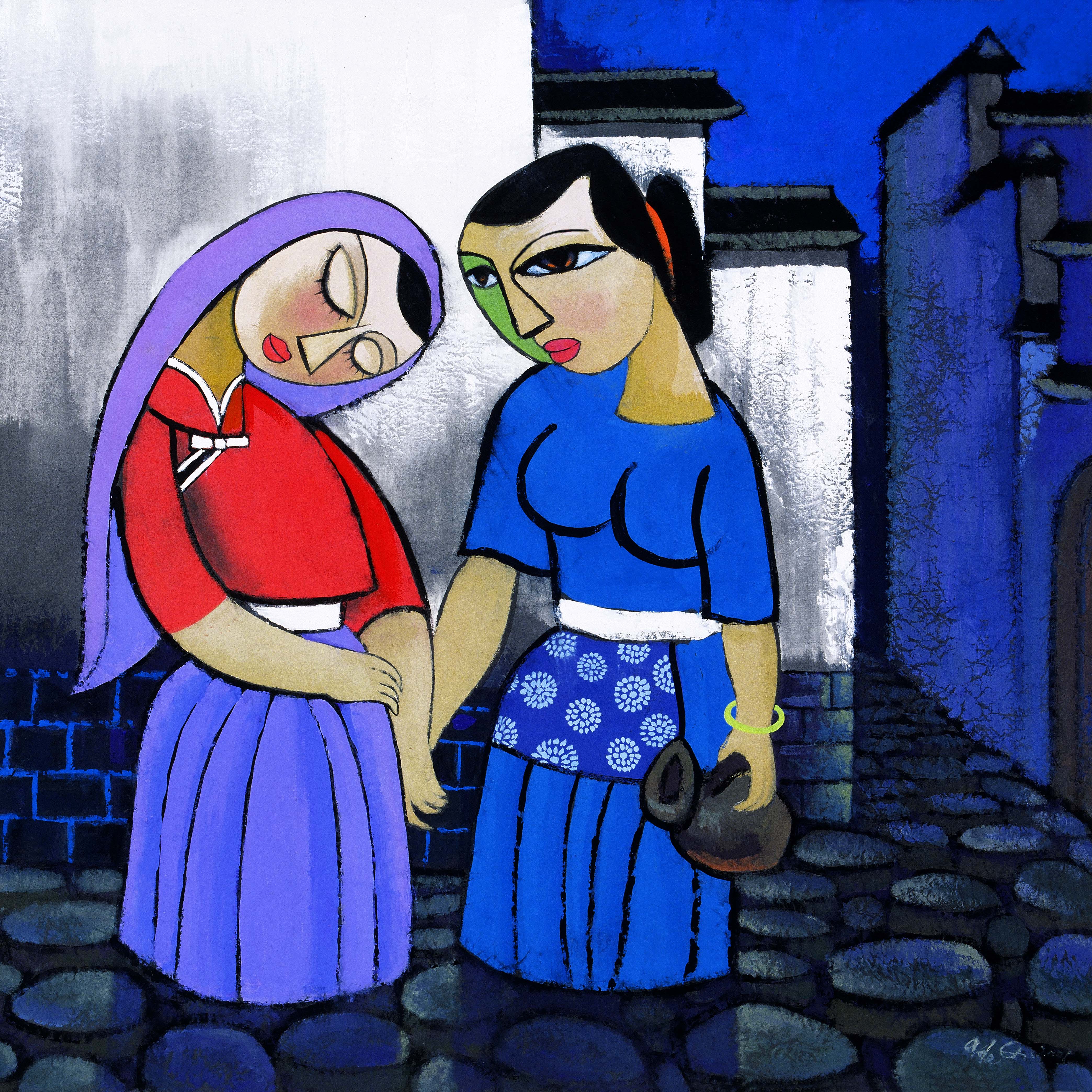
'The Visitation' - Hi Qi


Thursday, November 19, 2015

The End and The Beginning.

As Jesus was leaving the temple one of his disciples said to him, "Look Teacher! What massive stones! What magnificent buildings!"

"Do you see all these great buildings?" replied Jesus.  "Not one stone will be left on another, every one will be thrown down."

As Jesus was sitting on the Mount of Olives, opposite the temple, Peter, James, John and Andrew asked him privately, "When will these things happen and what will be the sign that they are to be fulfilled?"

Jesus said to them, "watch out that no one deceives you.  Many will come in my name claiming 'I am he', and will deceive many.  When you hear of wars and rumours of wars, do not be alarmed. Such things must happen, but the end is still to come.  Nation will rise against nation, and kingdom against kingdom.  There will be earthquakes in various places, and famine, these are the beginnings of birth pains.

Mark 13:1-8

Our story this week falls right on the heels of the widow's offering.  In fact, the disciples had just left the temple with Jesus; they had just seen the widow offer two small coins, less than a penny, to the treasury.   They had for a moment considered her small and simple act of love and the words of Jesus regarding this woman's offering:  "Truly I tell you this poor woman has put more into the treasury than all the others.  They gave out of their wealth, but she, out of her poverty, put in everything - all she had to live on."  It was a jarring juxtaposition to the wealthy walking by dropping in large sums.  Perhaps it made the disciples think back to Jesus' words on the first and the last, the foolish and the wise, the kingdom of the world and the kingdom of God.  But, if they had these thoughts they were fleeting at best.  No sooner were they out of the temple and the disciples were remarking: "Look! What massive stones! What beautiful buildings!"  After all, the kingdom of this world is so compelling with all its accomplishment and beauty.

Jesus uses this seemingly innocuous and yet remarkably ignorant comment: "Look! What massive stones! What beautiful buildings!" to speak to his disciples in what is the longest teaching of Christ in the book of Mark (we only have 8 verses of 37 in the chapter in our reading for today).  This teaching is remarkable because it stands at the intersection marking the end of Jesus public ministry before the time of his passion.  It is remarkable because it is an apocalyptic text like we find in Daniel and in Revelation - Jesus is pulling back the veil to reveal what has been, what is and what is to come.

"Do you see those great buildings," Jesus said to them, "not one stone will be left on another, every stone will be thrown down."  Despite what Jesus disciples knew of him and the earlier discourse in the temple, this would have unsettled, even shocked his followers.  This apocalypse with its' talk of wars, natural disaster and the destruction of the temple brings with it a warning of judgement on Israel, a judgement on sin. And yet, in the midst of this passing away the people can trust that the times are in God's hands - he will act to save them.

The disciples (well, James, John, Peter and Andrew) naturally want to know more: what will the signs be?  When will it happen? Perhaps if they can just get the inside scoop on this development they could be in a better position to manage it, to lead through it.  And what does Jesus say to them?  He offers parting words to them about how to live in the midst of the upheaval, destruction and death: "Watch out that no one deceives you.  Choose your leaders well. Be on guard! Do not be alarmed! This is not the end"  This ending is a beginning in and of itself, just as the pain of labour ends in new life.

In the days following these words of Jesus to his disciples he would be betrayed, arrested, deserted, wrongly accused, sentenced, mocked, hung and dead.  But in this ending God would have for us a beginning, he would make a way.  He would defeat death and usher in his reign forever.

Christ has died. Christ has risen. Christ will come again.
Salvation has been accomplished, is being accomplished and will be accomplished in the fullness of time.

In this week of terror and destruction in the world we recognize so acutely our own human tendencies towards fear and suspicion; towards xenophobia. We confess that in the midst of all that is unsettling and fearful we are vulnerable to wrong thinking, poor decision making, to sinful attitudes and actions.  Jesus words to us are especially poignant: do not be deceived, do not be alarmed.  Hold steady, endure.

This week my thoughts were drawn to Dr. King and the civil rights movement and their response to the  evil and terror that pervaded in their time.  I recently watched the movie 'Selma' which focuses on the marches from Selma to Montgomery that took place in an effort to pass the Voting Rights Act in 1965.  Despite the passing of the Civil Rights Act, one year earlier, black voters were still being turned away, unable to register, in the American South.  The first march in Selma turned violent as young segregationists attacked the peaceful march and in the ensuing chaos a young man, Jimmie Lee Jackson, was killed.  Dr. King appealed to the moral courage of all religious leaders to walk alongside the protesters in Selma for justice.  On March 9, 1965, religious leaders of all faiths responded to the call and came to Selma to walk with their brothers and sisters for freedom.  As the marchers crossed over the Edmund Pettis bridge, the state troopers in sight, Dr. King knelt down to pray, he then stood up and turned the march around. That night, James Reeb, a peaceful protester and a priest from Boston, was beaten to death by young segregationists.

Moral courage. Endurance.  The strength to love.  These words have been running through my mind this week.  How will we respond to the violence and hatred in the world? How do we walk with moral courage, endurance and strength to love and teach our children to do likewise?  Christ provides a way for us.  He shows us the way of forgiveness and love in the world through the cross.  This is the good news and the hard news.  It is the good news because we know the darkness of our own souls, we have sensed at times what we are capable of and we too can be forgiven, "we can live in freedom because the strong love of Christ has reached across all borders and all boundaries."(Andrew Murray Purra) And it is the hard news because if we are to take Jesus seriously, we are to see that we aren't that different than 'those people' and we are to follow Christ and meet him there in the face of the other because "God has assigned infinite value to all elements of society "(Fleming Rutledge).This is our participation in the exodus of Christ initiated through Jesus' death on the cross.  And this exodus is for all people and it is not limited to freedom from physical slavery but it "breaks the chains of slavery from all forms of sin and evil that bind the human spirit; it brings the promise of unending life and love and liberty as well as an unfettered relationship with God." (Andrew Murray Pura)

This Sunday is Reign of Christ Sunday and we sit with the jarring image of our crucified King identifying himself with all that is wrong and sad and shameful and broken in the world and yet has been redeemed through his death and made new.  And so the cross which stood as a notorious symbol of death has been subverted - the cross has become the way of life!  May it ever be before us.


Thursday, October 15, 2015

The Eye of The Needle

As he was setting out on a journey, a man ran up and knelt before him, and asked him, "Good Teacher, what must I do to inherit eternal life?"  Jesus said to him, "Why do you call me good?  No one is good but God alone.  You know the commandments: you shall not murder; You shall not commit adultery; You shall not steal; You shall not bear false witness; You shall not defraud; Honour your father and mother."  He said to him, "Teacher, I have kept all of these since my youth."  Jesus looked at him, loved him and said, "You lack one thing; go, sell what you own and give the money to the poor; and you will have treasure in heaven; then come follow me."  When he heard this, he was shocked and went away grieving, for he had many possessions.
Then Jesus looked around and said to his disciples, "How hard will it be for those who have wealth to enter the Kingdom of God!"  And the disciples were perplexed at these words.  But Jesus said to them again, "Children, how hard it is to enter the Kingdom of God!  It is easier for a camel to go through the eye of a needle than for one who is rich to enter the kingdom of God.  They were greatly astounded  and said to one another, "Then who can be saved?" Jesus looked at them and said, "For mortals it is impossible, but not for God; for God all things are possible."
Peter began to say to him, "Look, we have left everything and followed you."  Jesus said, "Truly I tell you there is no one who has left house or brothers or sisters or fields, for my sake and for the sake of the good news who will not receive a hundredfold now in this age - houses, brothers and sisters, mothers and children, fields, with persecutions - and in the age to come eternal life.  But many who are first will be last and the last will be first."

Mark 10:17-31

A man I know well tells a story from a time of great distress in his spiritual life.  He was respected man in his community and in his church.  He cared deeply about his faith and the local church and served many years on church boards. People regarded him as wise and prudent and sought his opinion on many things.  He was successful in his professional life and I suspect his 'net worth' reflected this though he never paraded around in expensive cars or flaunted a wealthy lifestyle.  He was a disciplined man and this discipline extended into his spiritual life where he had a pattern of waking early to read scripture and to pray.  During a particularly difficult time of being unsettled and dissatisfied in his spiritual life he asked the Lord, 'what has this all been for?  I have served you faithfully, I have given to the church, I have been faithful to your commandments and yet I feel like the man knocking on the door and never entering fully into life with you... the life that I have been working for and the one that I long for.'  In the quiet of this particular morning he heard the Lord tell him very clearly that he needed to give away more of his wealth.  He began to ask the Lord about this and to be obedient to him.  As he told the story to his children years later, the tears fell from his face when he recalled the morning that a great change began.  It remained a living Word, one that guided him into his later years and lead him into greater intimacy, joy, freedom and life than he had ever known in his walk with God.

I thought of him as I read this text from Mark. I suspect the man I know was grieved when he heard from the Lord that he needed to give away more of his wealth. He had not regarded his wealth as a barrier, he would have regarded himself as generous.  But God saw the Rich Man in both of these stories "and he looked at the man and he loved him." He loved them both enough to say, 'sell what you own, give it away and come follow me.'  It is not an easy invitation.  It stops us in our tracks, it grieves us, perplexes us, as it did the disciples.  In Judaism (and in our time) wealth was understood to be a sign of God's favour; it was inconceivable to the disciples that the wealth would be a barrier to following Jesus. But Jesus flatly rejected the merit based system of salvation based on good works accomplished by the rich.  In God's economy there is no favour in material possession or a lack thereof.  And the particular and pressing concern of wealth is the false sense of security it creates and the very real temptation to trust in material resources and its' power rather than God.  To underscore this important teaching Jesus says to his disciples, "Children how hard it is to enter the Kingdom of God, it would be easier for a camel to go through the eye of a needle than for one who is rich to enter the Kingdom of God."  Jesus intended this to be taken literally, it is an absurd image, the largest animal in the region and the smallest opening.  An utter impossibility.

But our salvation doesn't depend on our own ability to observe the commandments, to accomplish the impossible task of squeezing through the eye of the needle. Our salvation doesn't depend on who has given up the most or who won the race to the back of the line. Our salvation is a gift of God made possible through Christ.   And this gets back to the man's first question to Jesus: 'What can I do to inherit eternal life?'  Is inheritance earned? No, it is simply given because you are a part of the family. It is God who makes the impossible, possible; who, in Christ, gives us the great gift of being called his children and heirs to his kingdom.

Whenever I hear the words "with God all things are possible" I think back to Abraham and to Sarah who laughed at for years at the promise of God to them, "how can this be? I am past the age of having children?" Ah, but with God, all things are possible - life comes from barrenness, a dead girl is raised back to life, a destitute widow gives out of her poverty all she has to live on, a woman breaks an alabaster jar and anoints Jesus' head with priceless myrrh, Jesus receives, deep in prayer, strength to give his life for the sake of the world.  With God all things are possible.

There is another important and hard message for us in this story:  discipleship will cost us. Jesus lays claim to the whole person and following Jesus means the removal of any other support that impedes our obedience to him.  These losses for the gospel are costly and hard; the rich man walks away grieving. His satisfaction with the world had to be overcome with a greater desire for righteousness and life. 

This week I was laying beside Sophie in bed and after the usual bedtime chatter she said in a rather serious tone, "Mom, I have something to tell you."  "You can tell me anything, Soph," I responded.  Turning her face into the pillow she blurted out, "I love God more than you." I paused for a moment at her admonition "Oh Sophie, that is quite right.  I know you love me and I love you.  But to love God most is a good thing."  "But it feels weird to say, Mom."  "I understand that, Sophie but it doesn't mean you don't love me A LOT, God is teaching you something very important.  It is a good thing."  

The Spirit of God came upon the man in the distress of his soul and the quiet of the morning and the little girl at night who confessed that she loved God more than her mom and he began to teach them and transform them and lead them into life.


Sunday, October 11, 2015

A Samaritan Leper Says Thank You!

On the way to Jerusalem Jesus was going through the region between Samaria and Galilee.  As he entered a village, ten lepers approached him.  Keeping their distance they called out saying, "Jesus, Master have mercy on us!" When he saw them, he said to them, "Go and show yourselves to the priests." And as they went they were made clean.  Then one of them, when he saw that he was healed, turned back, praising God with a loud voice.  He prostrated himself at Jesus' feet and thanked him.  And he was a Samaritan.  Then Jesus asked, "Were not ten made clean? But the other nine, where are they?  Was none of them found to return and give praise to God except this foreigner?" Then he said to him, "Get up and go on your way; your faith has made you well."

Luke 17:11-19

Is it possible that the beauty of a sunset could be the beginning of faith? A theology professor tells the story of a friend who, facing a cancer diagnoses and a long road of treatment, took a journey to the European Alps to fulfill a lifelong dream. In the Alps, surrounded by the beauty of creation, she felt an overwhelming gratitude welling up in her and a desire to say 'thank you.'  This desire puzzled and unsettled her.  Where was this coming from? Who would she say 'thank you' to?  This question remained with her as she returned home and it set her on a path to knowing Christ as the creator and redeemer of the whole world. Her faith began with a simple thank you. Gratitude that brings us to Jesus changes us.

In this story Luke indicates that thanksgiving gives way to faith which in turn becomes sozo: salvation, wholeness.  The Samaritan leper realizing that he has been healed, stops, turns around and praises God in a loud voice, falls down at Jesus' feet and thanks him.  For me it is as lavish as the woman who pours perfume on Jesus' feet and washes them with her hair.  This is an equally evocative expression of love and thanksgiving. The loud voice, the falling down, the thank you's uttered amidst tears and laughter - they belong to a man who sees Jesus and responds with unrestrained passion and thanksgiving. As for the others they are thankful I am sure, but they are racing to the priest, thinking about getting cleared for re-entry back into their families and the community.  And on their way they do not stop to say thank you.

Have you ever wondered what this Samaritan was doing amidst the other Jewish lepers?  Was it the leprosy that broke down the barriers so they could see their common humanity?  So that together with one voice they could say: "Jesus, Master, Have Mercy on Us" Have you ever wondered what happened to this Samaritan after they were are all healed?  Because the truth is this Samaritan is still an outsider. If he were to go to the priest would he even be received?  This Samaritan turns back to the Jewish man who just told him to go to the Priest, and in his turning, in his unrestrained thanksgiving, through his faith in Jesus he receives sozo - salvation: wholeness! It is the thanksgiving that he lays down; that he shouts out that prepares the way for his full restoration. This is Luke's second story about a Samaritan, I think he is being intentional and instructive in this; he is working on the assumptions of the hearers, he is breaking down barriers, he is telling them that the salvation of God is for all people.  And guess what? The outsiders they just might be the ones who see it, turn around and receive it while the insiders pass on by.

Thanksgiving is what this Samaritan outsider expresses that the others do not.  It is the reflexive, intuitive response muttered by the woman in the Alps, it is the broken perfume bottle by Jesus' feet.  It is a discipline that we practice by which we learn to see the mercy and grace of God all around us.  Through thanksgiving we grow in joy, we grow in faith.  It is what enables us to persist in the darkest times.  It is intimately connected with our salvation: "Those who bring thanksgiving as their sacrifice honour me; to those who go the right way I will show the salvation of God" (Psalm 50:23).  They are the words of Jesus himself who "on the night when he was betrayed took a loaf of bread, and when he had given thanks, he broke it and said, This is my body that is for you..." He gave thanks ... Eucharisteo.  Communion.  His brokenness - his body and blood - has become our salvation.  The bread and the wine.  The eucharistic life - the life that we partake in and celebrate each week - is a life of thanksgiving.

Hear the beginning of the eucharistic prayer:

The Lord be with you
And also with you

Lift up your hearts
We lift them to the Lord

Let us give thanks to the Lord our God
It is right to give our thanks and praise

It is indeed our right
It is our duty and our joy
at all times and in all places
to give you thanks and praise....

The children are usually upstairs for the eucharistic prayer and I think it would be wonderful if we could draw their attention this prayer today - to notice the words, the instruction to live lives of thanksgiving because it is our duty and our joy.  Sometimes thankfulness overtakes us, it is as easy as our very breath. And sometimes it is a great challenge to be thankful in the face of the suffering that surrounds us all.  Yet we learn with Christ, with Paul, with our brothers and sisters that turning to God and giving thanks even in the midst of suffering offers us a way through our pain - a way of seeing and experiencing the mercy of God.

This morning at Moms' Group we discussed this text from Luke. In our meandering conversation we discussed the miraculous way in which thanksgiving can give way to faith, we heard how some people practice the discipline of thanksgiving individually and with children.  We sat in silence as we considered how lament and grief co-exist with thanksgiving; some women shared how gratitude sustained them in the darkest times.  At the end of our time we prayed, we gave thanks for simple, beautiful things: for trees alive with colour, for sunlight through lead glass windows, for a hand to hold, the company of a friend, a cup of coffee; for the people we hold dear: those who are with us and those who have passed on.  We gave thanks for the love and faithfulness of God. For salvation. For joy. For the hope that we have in Christ who gives us the strength to endure: to make it through the hard days, the diagnoses, the losses. And as we offered our thanksgiving I felt the tears begin to roll down my face. Is not thanksgiving where we learn humility?  Who am I God to know these graces, these mercies?  May I too say thank you with a loud voice, fall down at your feet and worship you.

Thursday, October 1, 2015

How We Live Before God and Others Matters.

The text we have for this week is difficult; whether you read it aloud in church, alone in your room or with children(!) it is simply not easy.  As I read this text I wondered whether or not we should skip over it - all of this talk of cutting off hands or feet, plucking eyes and eternal fire is a little dark, isn't it?  How does a child hear this?  But then I find myself wondering if we only focus on Jesus as loving, sacrificial and wise and leave too little room for holy, and just and other. I wonder if we soft-sell discipleship.  Following Jesus is not (always) straightforward and joyful - do we set children and youth up for confusion and disappointment when they discover it to be difficult and costly? I always try and emphasize with children that God's stories and our own stories are full of people/us encountering struggle. There is no way around suffering for the disciple, but we do know that God is faithful and he will provide us with a way through and lead us into LIFE.

So what do we do with the demanding teachings of the new testament? Do we tell them to the children - and if so, is there are correct age? It's true that not all stories are age appropriate. Some teachings are too nuanced; if they were taken literally their meaning would be missed. But, the threads of judgement and mercy, the realities of life, sin and the call of God on humans are all throughout the scripture. From the garden of Eden, to the tower of Babel, in the story of Noah, with Abraham and Isaac on Mt. Moriah, Moses on the threshold of the promised land; in the life of David, and in the prophets.  As we encounter Jesus we meet God who is gracious and compassionate, slow to anger and rich in love. (Psam 145:8)


I am going to write a few things about this Sunday. Take what is useful and helpful for your class this week.

The text for this week (Mark 9:38-50) from the Message reads:

John spoke up and said, "Teacher, we saw a man using your name to expel demons and we stopped him because he wasn't in our group."
Jesus wasn't pleased.  "Don't stop him.  No one can use my name to do something good and powerful and in the next breath cut me down.  If he's not an enemy, he's an ally.  Why anyone, by giving you a cup of water in my name, is on our side.  Count on it that God will notice.
On the other hand, if you give one of these simple, childlike believers a hard time, bullying or taking advantage of their simple trust, you'll soon wish you hadn't.  You'd be better dropped in the lake with a millstone around your neck.
If your hand or your foot gets in the way, chop it off and throw it away.  You're better off maimed or lame and alive than the proud owner of two hands and two feet,  godless in a furnace of eternal fire.  And if your eye distracts you from God, pull it out and throw it away.  You're better off one eyed and alive than exercising your twenty-twenty vision from inside the fire of hell.
Everyone's going through a refining fire sooner or later, but you'll be well-preserved, protected from eternal flames.  Be preservatives yourselves.  Preserve the peace.

From the epistle of James we read:

Are you hurting? Pray.  Do you feel great? Sing.  Are you sick? Call the church leaders to pray for you and anoint you with oil in the name of Jesus.  Believing prayers will heal you and Jesus will put you on your feet.  And if you've sinned, you'll be forgiven - healed inside and out.
Make this your common practice: Confess you sins to each other and pray for each other so that you can live together whole and healed.  The prayer of a person living right with God is something to be reckoned with.  Elijah for instance, human just like us, prayed hard that it wouldn't rain and it didn't - not a drop for three and a half years.  Then he prayed that it would rain, and it did.  The showers came and everything started growing again.
My friend, if you know people who have wandered off from God's truth, don't write them off.  Go after them.  Get them back so that they are rescued from wandering away from God.
James 5:13-20

Regarding the Gospel:

I think the first verse is apt for children.  I have often heard kids talk about their friends in other churches and wonder if they are Christians.  Children have a tendency (just like adults) to separate people into groups and to be suspicious of those who are in groups other than theirs.  In this text the disciples have taken note of a group of people who are healing in Jesus name but are not a part of their group. Jesus says, "Everyone who is not against me, if for me.  If people are doing good in my name, God will notice. You can count on it."  Perhaps you can highlight other churches in our community that are doing good.  Tell about what God is doing in the church in our city and be encouraged.  You can even bring in some pictures of other churches.  This Sunday is World Communion Sunday (one could argue, every Sunday is World Communion Sunday) nevertheless, it is good practice to draw attention to the fact that we gather with believers around the world. One body, sharing in one cup and one bread!

This reading also emphasizes the importance of us not causing other Christians to sin.   How do we encourage people to sin?  Maybe we draw people into gossip by whispering about others? Maybe we hurt another in the words that we say by telling others things that aren't true about who they are or who God is and they fall into wrong ways of thinking or acting. Jesus wants us to look out for each other and encourage faith in one another, when we are sinning against other people/causing others to sin, we break down community.  Perhaps they can recognize this in their families: "don't tell mom and dad what we are doing... go and get that $5 on the counter and bring it to me, mom won't care...." These are little examples but they show how we draw people into our web of sin. Jesus cares a lot about how his followers/the body of Christ/ the church treat one another.  After all, we are his body on earth! We are to show the world the love and forgiveness of Jesus. How can we do this if we don't treat each other well?

The verses about chopping off limbs and sin connect back to the lesson from last week which talks about sacrifice. These verses are not a demand for physical self-mutilation. They are, however, filled with very strong and attention-grabbing language in calling for Jesus' followers to get rid of whatever in life tempts us to be untrue to God.  I wonder what the children would identify as things which get in the way of following God and loving others.

We are to be the salt of the earth (Be preservatives yourselves! The Message, Mark 9:). We are the salt of the earth when we don't worry about rank or position but when recognize in one another a common commitment to Jesus, to the gospel and to the life of a servant.

Regarding James:

I like the passage alongside the gospel because it talks about the practices of Christian community:  "If you are hurting, pray.  If you are joyful, sing. Are you sick?  Call the church elders to pray for you to anoint you with oil... confess your sins to each other so that you can live together whole and healed."

This is a great opportunity for us to talk about these four forms of prayer throughout the week and on Sunday morning.  Do you pray when you are hurting? How do we do this on Sunday morning?  Do you ever sing when you are joyful? Do you have a favourite song that you like to sing? Does our church do prayers of anointing? What does it look like?  Perhaps you might ask someone from prayer ministry to come to your class, show you some anointing oil and introduce your class to prayers of anointing.

It is worth mentioning that not all prayers are answered the way we hope or can see at the time.  I am sure Elijah prayed for things in his life that were not answered how he had hoped.  When our prayers aren't answered in the way we prayed it doesn't mean God isn't real, isn't listening to you or doesn't love you or me.  Praying to God isn't like rubbing a genie. Praying to God is entering into the heart of love, it is listening to Jesus, it is bringing ourselves before God, it is confessing our sin, giving thanks, praying for others, it is mystery and revelation.

I picked up a great little book this summer entitled: Drawing Our Prayers by Sybil MacBeth.  It gives children and adults some tools for praying through drawing: confessing, praying for others, using symbols, listening.  I would recommend spending time in prayer this week including prayers of thanksgiving, listening, confession and praying for others.  If you would like me to scan you some ideas from the book just let me know!


 May God be with you and the children in your class!

I give thanks to God whenever I think of you!

- Sara


Wednesday, September 23, 2015

Who Is the Greatest?

They left that place and passed through Galilee. Jesus did not want anyone to know where they were because he was teaching his disciples.  He said to them, "The Son of Man is going to be delivered over to human hands. He will be killed and after three days he will rise.  But they did not understand what he meant and were afraid to ask him about it.
They came to Capernaum.  When he was in the house, he asked them, "What were you arguing about on the road?" But they kept quiet because on the way they had argued about who had been the greatest.
Sitting down Jesus called the Twelve and said, "Anyone who wants to be first must be the very last, and the servant of all."
He took a little child whom he placed among them.  Taking the child in his arms he said to them, "Whoever welcomes one of these little ones in my name welcomes me, and whoever welcomes me does not welcome me but the one who sent me."

Mark 9:30-37

If you were in the service this past Sunday you heard this Mark 9 text followed by Ian MacLaren's excellent words of exhortation regarding our Christian duty to love our neighbours and care for those in need.  I attended the 8 am service and as this scripture was being read a friend began to laugh out loud as she thought about those bickering disciples. You can picture it can't you?

"Listen up," John says, "I know I am right about this.  I am the one who knows the Lord best, he always chooses me to help him out."  Peter objects, "well if you know him so well how come you were so slow to identify Him as the Messiah, I believe I was the only one to speak that out."  "Ya, Peter, of course you said it. You are always the first to speak BUT we ALL thought it," Andrew retorts impatiently.  "Does being chosen to "help out" or being the first one to speak make you better than the rest of us?"  The conversation on the road to Capernaum was rapidly deteriorating as disciples argued about who was the greatest.

My friend laughed because this conversation is foolish and immature and decidedly human. It is what we discover as sibling rivalry in our homes, what we see in the classroom every day as children elbow, push, whine and jockey to be first. This incessant striving, this dogged self determination, this me-first attitude is not our childishness however, it is our human nature in full view.  This story from Mark isn't about school children after all, it is about grown men wanting to assert themselves and establish dominance over one another.  This is our story too and while it does produce some measure of greatness it often leaves a trail of devastation in its wake. To enter the competition for greatness in the world you have to be willing to sacrifice relationships, putting yourself and your ambition ahead of everything else. We offer up endless praise to people who do this; we tell stories of their self discipline and sacrifice and courage.  The stories about the people who were used along the way, the rules that were bent and the cost of cut throat competition on one's soul is a lesser told story, but we know it too.  Jesus words expose our strivings, our desires and reveal a deeper truth about God and his Kingdom.

Sitting down Jesus called the Twelve and said, "Anyone who wants to be first in my Kingdom must be the very last and the servant of all."  The ways and means of greatness on earth are not the ways and means of greatness in God's kingdom.

It is not our way to look first to serve others.  It is not our way to give up our positions of preference or power. Most often we look to others to serve our needs so that we can be first, not last. We wonder what someone else might have to offer us, whether it is social capital, time, help, access to something we want.  Take a moment to think about how this is true in your life. Have you ever pursued a relationship with someone because the relationship helped you to get something you wanted, not because you were first interested in the friendship of the other person?  Perhaps you have you been on the receiving end of this? Remember the palpable panic in your university classes when group projects were assigned and everyone clamoured to claim 'the great ones' who would be the key to the good grade?  Or the time when you skillfully identified the one neighbour or school mom or colleague who seemed to unlock a whole social world for you. This is all wrapped up in what Jesus is talking about, positioning ourselves for 'greatness' - using people for our own ends instead of serving people towards the end of loving our neighbours and loving God.

Jesus envisions an entirely different way of being. Looking around he picked up up a small child from amongst them and said, "whoever welcomes one of these little ones in my name, welcomes me and whoever welcomes me does not welcome me but the one who sent me."  Jesus' love for children is clear but he wasn't speaking exclusively about welcoming children. In this text and later on in chapter 9 Jesus is speaking of the child as a disciple/servant.  He is exhorting the disciples to become like children who have no basis of pretensions to greatness.  The small child in this story becomes an example of discipleship.  Therefore to receive a child (a disciple of Christ sent by Him) is the equivalent of receiving Jesus.  To the disciples Jesus says, whoever receives you, receives me and the Father who sent me.  

As followers he calls us to  to give up our spots (our privilege/our greatness) at the front of the line by way of serving and loving others in a child-like way, not seeking after greatness but serving with a pure heart.  Jesus imbues this call to the servant life with the utmost dignity by telling the disciples that anyone who welcomes you, welcomes me.  This is holy work.

Like the disciples it is easy for us to find ourselves jealous, bickering, striving for greatness by the world's standard. Jesus wants to counter that tendency in us by always keeping before us the goal of loving service of others.  Could it be that serving one another in love is the antidote to endless striving and competition? What does service look like for us and for the children?  How does loving service change our homes, our schools, the playground, our work places?

Can you think of people who exemplify this life of love and sacrifice for others?  Tell these stories to the children this week.  Our leaflets and learning materials may tell stories of Mother Theresa and other well known disciples and while these are worthwhile stories to tell, they can sometimes end up being about greatness in their own way.  I am sure Mother Theresa herself would rather you told stories of ordinary people in your life who model Christian discipleship.

If you are looking for a story to tell illustrating what the fruits of comparing, competing and posturing can produce in our lives, I have two: Yertle the Turtle by Dr. Seuss and The Pain and The Great One by Judy Blume.  Let me know if you are interested in either of these stories.

May we in our own lives become like little children who are not concerned about greatness; may our service keep us humble and grateful and may we encounter Christ as we follow him in this way.


Wednesday, September 16, 2015

Kids' Word is Underway for the 2015/16 School Year!

Last week we met with our classes for the first Sunday of this school year.  In our Grade 4 class I asked the students why they come to church.  The responses varied: worshipping God, giving thanks to him, confessing that we need God, being with other people who are Christian - who believe what I believe and who pray with me.  In the responses that were shared I repeatedly heard children mention 'other people'. There was an acknowledgement that we cannot be Christian all on our own, we need each other. Children need the Church! Sometimes as adults we consider far too lightly the need children have for faith community. We think Sunday School has some merit for them but we may not appreciate their need to be formed in God's story, as people who belong to Christ.

This summer I spoke at camp and I was struck with the responses that children had to the Bible; in one week we gave out an entire box of bibles! One girl had the courage to come and ask me to read the bible with her during free time.  She wanted to know how she could read it on her own; where should she start in this big book? Another boy, on the night of the camp out, asked a leader if they could read more of the stories of David from 1Samuel together.  I teach kids from the bible all year long and here I was surprised by the interest Children had in the Bible!  I am slow to learn. Children are fed by the scriptures too and they need to have the word of God opened up for them.

Our children are also in the process of developing a Christian worldview in a very secular context, they are trying to figure out what it means to be Christian in the world they inhabit.  This past week my daughter had to take a "Me Bag" to school; she packed four items into a small sac: a copy of Anne of Green Gables, her soccer jersey, a prized ribbon and her cross.  I know that her baptismal identity and her sense of belonging to our church give her confidence to bring her cross to her class. As a parent I am grateful for the formation she has received from our community of faith, for all of the people who have been pouring into her life.  Children need the encouragement of other Christians. They need to see people of all ages worshipping God, they need the songs, the sacraments, they need a place of contribution within a community, they need a place to ask questions, to learn prayer and be prayed for.  They need church in much the same way we do.  

Last Sunday I was humbled by the ways in which the children confessed their need to gather as the church.  Far too often adults develop cynicism and question the value of gathering as the church.  May the enthusiasm our children have for church instruct us all.

We did self portraits on Sunday; keep your eyes open for them this fall!  And as you see them be reminded: we are the church, together we are the body of Christ on earth!

This Fall we are moving through the lectionary and in particular the book of Mark between chapters 8-13.

September 20: Peter's Faith Mark 8:27-38
September 27: Who's the Greatest, Mark 9:30-37
October 4: Share God's Love, Mark 9:38-50
October 11: Thanksgiving Sunday - A Large Group Reflection/Activity
October 18: A Rich Man's Questions, Mark 10:17-31
October 25: James and John, Mark 10:35-45
November 1: All Saints' Day - An Intergenerational Service
November 8: Bartimaeus Sees, Mark 10: 46-52
November 15: A Widow's Offering, Mark 12:38-44
November 22: Christ the King Sunday/Be Ready John 18:33-37, Mark 13:1-8

I hope we can also encourage our older students to read the book of Mark. Students grade three and up will find a reading schedule they make take home with them; it breaks the book of Mark into 30 readings which they can tackle throughout the next few months.   Perhaps we can offer some incentive for reading the scripture before Advent begins on November 29 (Donuts/Breakfast/Fruit)  Let's encourage students to share some of what they are wondering about/learning as they read the book of Mark and as we study it together.  I have also found the book of Mark as a picture book, it is due for release mid-October and as soon as I have it, I will make it available to your classes.


Peter's Faith

Mark 8:27-38

Jesus went on with his disciples to the villages of Caesarea Phillippi; and on the way he asked his disciples, "Who do people say that I am ?"  And they answered him, "John the Baptist; and others, Elijah; and still others, one of the prophets."  He asked them, "But who do you say that I am?" Peter answered him, "You are the Messiah."  And he sternly ordered them not to tell anyone about him.

Then he began to teach them that the Son of Man must undergo great suffering and be rejected by the elders, and the chief priests, and the scribes, and be killed, and three days rise again.  He said all this quite openly.  And Peter took him aside and began to rebuke him.  But turning and looking at the disciples, he rebuked Peter and said, "Get behind me, Satan! For you are setting your mind not on divine things but on human things."

He called the crowd with his disciples and said to them, "If any want to become my followers, let them deny themselves and take up their cross and follow me.  For those who want to save their life will lose it, and those who lose their life for my sake and the sake of the gospel will save it.  For what will it profit them to gain the whole world and forfeit their life? Indeed, what can they give in return for their life?  Those who are ashamed of me and my words in this adulterous and sinful generation, of them the Son of Man will also be ashamed when he comes in the glory of his Father with holy angels."

***********

This Fall we are in Year B of the Lectionary readings which places us in the last half of the Gospel according to Mark. It might seem an odd place to begin a year but, in fact it begins with two poignant questions: Who do you say that I am/Who is Jesus? and What does it mean to follow Jesus?  These will be good questions to keep before us as we gather together this fall.

Who was Jesus? What were people saying about him at this point?  He had certainly gathered notoriety in the region; his teachings were gaining large audiences. Just prior to Jesus asking this question four thousand people had followed him up a hillside to hear him speak; to everyone's astonishment (except maybe the boy who brought him the bread and fish) he fed them all.  He had raised a girl from the dead, cast out demons, healed a man who was paralyzed. A woman who had been bleeding for years touched them hem of his cloak and was also healed.  He had gathered disciples to him and sent them out with authority, preaching repentance, driving out demons and healing people.  King Herod knew about Jesus; he was circling around him, wondering who he was, wondering if John, whom he had beheaded, had been raised from the dead, or if Jesus was actually Elijah or if Jesus was a prophet like ones from ages past.  His identity eluded people.  He ate with the unclean, he associated with sinners, he taught on the sabbath.  The disciples knew what people were saying. They had heard people wrestle with the question: "Who is this man who speaks with this authority; even unclean spirits obey him." (Mark 1:27)

But when Jesus turned this question to them, what would the disciples say?  Who did they know Jesus as?

This is a shining moment for Peter, the man who is sometimes most well known for being impetuous and double minded.  He answered almost instinctively: "You are the Messiah." It is a moment of seeing - Jesus is the Messiah, the Christ.

What does the word Messiah mean?  Be sure to ask the children.   Messiah is a Hebrew word, we know it from the old testament as meaning anointed one.  The children will think of David, who was chosen by God and anointed by Samuel.  It means: royal, priestly, prophetic, given over to God's service and under his protection.  It meant a special relationship to God and to His people.  The people expected a messiah to come from the line of David, an appointed agent of God whose coming would mark the fulfillment of the divine promise and the realization of Israel's hopes. Jesus is indeed the one to bring in God's Kingdom!  This is an astonishing moment for the disciples.  Jesus does not deny this, he accepts Peter's confession but then says, "do not tell anyone."  The Jewish people had ideas of what it would look like to be liberated by a Messiah and how it would happen.  But Jesus needed to show them the Messiahship God had ordained, that was spoken of through Isaiah.

Isaiah 53:

Who has believed what we have heard?
    And to whom has the arm of the Lord been revealed?
For he grew up before him like a young plant,
    and like a root out of dry ground;
he had no form or majesty that we should look at him,
    nothing in his appearance that we should desire him.
He was despised and rejected by others;
    a man of suffering[a] and acquainted with infirmity;
and as one from whom others hide their faces[b]
    he was despised, and we held him of no account.
Surely he has borne our infirmities
    and carried our diseases;
yet we accounted him stricken,
    struck down by God, and afflicted.
But he was wounded for our transgressions,
    crushed for our iniquities;
upon him was the punishment that made us whole,
    and by his bruises we are healed.


No one would have desired or expected Jesus' messiahship to include: "great suffering, rejection by the chief priests, elders, scribes - death and resurrection."

This sounded so strange and so devastating to the disciples that Peter took Jesus aside to rebuke him - do not speak these things, surely not, Lord.  But Jesus words were stronger yet, "Get behind me, Satan."  This phrase brings to mind Jesus' temptation in the wilderness and perhaps revealed to Peter that he is not that different than the Jews who want to be delivered by military power.  It is a stinging rebuke - how quickly we can move between a moment of clarity and being obscured by our own ideas, hopes, philosophies and fail to see Christ.

Those of us reading the scripture today have the advantage of knowing the story and it's trajectory but for the disciples in the midst of this revelation, which included the death of Jesus (?!), trying to understand the work of God in Christ challenged them on every level.  They had to give over their own ideas of who they wanted the Messiah to be, the ways and means by which they wanted salvation accomplished.  They had to trust and follow Jesus. But wouldn't these words of suffering and death have profound implications for them?

Soon after Jesus has spoken of his Messiahship, he spoke to the crowd and his disciples saying, "if anyone would come after me he must deny himself, pick up his cross and follow me.... for whoever loses his life for me and the gospel will save it."  In other words: give your life to me, put serving and loving me first and you will find LIFE. John Stott writes this:  "If you acknowledge that life is not yours by right, that all is privilege, and that it is to be lived in the love that the gospel story reveals. There is now nothing to lose and everything to gain.  Suppose you gain all the worlds riches but lose the inner freedom of loving and being loved by God - what then?  What will you give in exchange for the divinely given inwardness, which is the centre of all that is spiritual, the aspect of everything you are, the space God wishes to dwell?  These are the choices being offered by Jesus, Messiah, Son of Man.  The apparently gloomy news of the cross is now the way to total freedom and fulfillment" (Stott, the message of mark, p. 161).  Jesus gave himself up on the cross for love of his people, that we might be saved from the sin and death and set free, that we might be healed and made whole.  Our right response to the good news is to live in the light of God's love and to give ourselves wholeheartedly to Jesus.

This past Sunday was Feast of the Holy Cross - how appropriate to take some time to reflect on the meaning and significance of the cross.  Have children note how many crosses we have around the church. Why do people wear them on their necks?  Encourage the kids to consider what the cross means and what it looks like to give our lives to Jesus.

I look forward to what we will learn about who Jesus is and what it means to be his followers in this particular time and place.

God be with you as you share the Gospel with children this week.


Tuesday, June 9, 2015

June 14: A Morning of Blessing and Celebration!


On one particular Sunday this year, a grade three student burst into the classroom and said, "I cannot wait for the blessing today!" Each week he crosses his arms, leans eagerly over the rail and waits to hear the priest say words that affirm his belovedness.  His desire for the blessing is instructive to me, more than anything he wants to hear words that call forth what is most true about who he is.  Amongst all the other competing, demanding, distracting voices in a week, this voice of blessing is the one he longs for.

In his book, The Life of the Beloved, Henri Nouwen says this of blessing:

"In Latin, to bless is benedicere.  The word, "benediction" that is used in many churches means literally: speaking (dictio) well (bene) or saying good things of someone.  To give someone a blessing is the most significant affirmation we can offer.  It is more than a word of praise or appreciation; it is more than pointing out someone's talents or good deeds; it is more than putting someone in the light.  To give a blessing is to affirm, to say "yes" to a person's Belovedness."

One of the Hebrew translations for the word Bless is 'barak' which means to praise, to congratulate, to salute.  It can also be translated 'esher' which is translated as happiness, "Blessed is the man who does not walk in the counsel of the wicked, or stand in the way of sinners, or sit in the seat of mockers but his delight is in the law of the Lord and in his law he meditates day and night.  He shall be like a tree planted by streams of water, which yields fruit in its season, whose leaf does not wither and whatever he does prospers."  If you remember when we we looked at Beatitudes this year we used the words, "God is on the side of..."instead of "blessed" to get a fulsome understanding of the word Blessed in that context.  In the Bible 'to bless' carries with it a number of connotations but it is never a weak word.  For our purposes we will share words with one another that affirm our Belovedness, God's work in us, the unique gifts that each of us have.

Here is a further excerpt from The Life of the Beloved by Henry Nouwen, on blessing:

Not long ago in my own community, I had a very personal experience of the power of a real blessing.  Shortly before I started a prayer service in one of our houses, Janet, a handicapped member of our community said to me: "Henri, can you give me a blessing?"  I responded in a somewhat automatic way by tracing with my thumb the sign of the cross on her forehead.  Instead of being grateful however, she vehemently protested, "No that doesn't work, I want a real blessing."  I suddenly became aware of the ritualistic quality of my response to her request and said, "Oh, I am sorry... Let me give you a real blessing when we are all together at the prayer service."  She nodded with a smile and I realized that something special was required of me.  After the service when about thirty people sitting in a circle on the floor, I said, "Janet has asked me for a special blessing." She stood up and walked toward me.  I was wearing a long white robe with ample sleeves covering my hands as well as my arms.  Spontaneously Janet put her arms around me and put her head against my chest.  Without thinking I covered her with my sleeves so that she almost vanished in the folds of my robe.  As we held each other, I said, "Janet, I want you to know that you are God's Beloved Daughter.  You are precious in God's eyes.  Your beautiful smile, your kindness to the people in your house and all the good things you do show us the beautiful human being that you are.  I know that you are feeling a little low these days and that there is a sadness in your heart, but I want you to remember who you are: a very special person, deeply loved by God and all the people who are here with you."

As I said these words, Janet raised her head and looked at me; her broad smile showed me that she had really heard and received the blessing.  When she returned to her place, Jane, another handicapped stood up and said, "I want a blessing too."... The most touching moment, however, came when one of the assistants, a 24 year old student, raised his hand and said, "And what about me?" "Sure, " I said, "Come."  He came and as we stood before each other, I put my arms around him and said, "John it is so good that you are here.  You are God's Beloved Son.  Your presence is a joy for all of us.  When things are hard and life is burdensome, always remember that you are loved with an everlasting love."  As I spoke these words he looked at me with tears in his eyes and said, "Thank you, thank you very much." 

That evening I recognized the importance of blessing and being blessed and I reclaimed it as a true sign of the Beloved.  The blessings that we give each other are expressions of the blessing that rests on us from all eternity...


(from pages 69-72)

Let us bless one another this week and celebrate that we are all God's beloved children.  For younger students in Grades 1 and 2 I think it might be appropriate if each student had a large heart shape or if they made a card with their name and a drawing on the front.  Perhaps we could write the blessing from Numbers 6:24-26 on each heart or card:"The Lord bless you and keep you, the Lord make his face shine upon you, the Lord be gracious to you and give you peace." Then children can write something that they appreciate about each person on their heart/card.  Perhaps it would be good to brainstorm a number of phrases for blessing then students can pick from that list what they want to say about each person.

Here are some examples:

You are joyful
You are kind
You are a good friend
You are funny and you make people laugh
You think of other people and make everyone feel welcome
You are fun
You encourage me
May God be with you this summer
May you have a peaceful summer
May you have joy playing outside
May you have peace in your house


In the older grades some direction might also be helpful; you might want to have the students make cards with their names and a drawing on the front and on the inside they can write blessings - something that they appreciate about each person and a prayer of blessing for the summer ahead:

May God watch over you and keep you
May you know the love of God for you
May you have peace this summer
May you have joy doing ________

If you come early you might want to write a few words of blessing for each student; you may even want to read your blessings aloud to the kids at some point in the morning. Do this only if you have one for every student and if a new student comes you will have to be prepared to write out a blessing,  in this case you could write out the blessing mentioned above from Numbers.

After you have finished your cards of blessing you may want to take time to share about summer plans.  Ask the children to share about what they are looking forward to and what they are feeling a bit nervous or uncertain about as they head into the summer months.  Some children who are going to summer camp may be feeling excited and still a little unsure about being away from home. For other children being home all summer might be weighing on their minds particularly if their friends are going away - summer can be lonely for some kids.  I am always mindful that while summer holidays is greatly anticipated by some, for others it is not so carefree.  Please take the time to pray for one another in your classes.  Our Grade six students are writing PAT exams and they will certainly appreciate prayer for the upcoming week.  Please give students the opportunity to share and to pray for one another: you may do this out loud or you may pray as you draw together writing each other's names, writing words or symbols and using colour to express your thoughts you can use the paper on your tables or alternatively I can provide you with paper. It is up to you!

Feel free to bring treats that everyone can share.  Please contact me if you have questions about allergies in your class.  Alternatively if there is a craft or activity you would like to do to wrap up the year, let me know I will happily get you the supplies you need.

I hope this morning will be a lovely time of blessing and celebration!